Mailjet - No Success Tax
Mailjet - No Success Tax
Mailjet is an email marketing platform competing in a crowded market dominated by well-established players. The brief was to create a paid campaign that could cut through — and after studying our product's positioning it was clear that this would be done not through our features, but our pricing model.
The challenge then was to explain very abstract concepts in a way that's immediate, visual, and worth stopping for.

Research
Research
A different kind of pricing. A tricky brief.
This project started from the intention of running an ad campaign aimed at our very established competitors, targeting customers on the verge of making a decision. In order to sell Mailjet as the best choice, our pricing model was our best tool.
Most email platforms charge you twice: once per email sent, and again for every contact stored in your database. The bigger your list grows, the more you pay, just for having it.
Mailjet doesn't work that way. You only pay per email sent. Your contacts are free to store, no matter how many.
It's a meaningful difference, especially for growing businesses. But "we have a different pricing model" is not a campaign. The real question was: how do you turn an abstract pricing mechanic into something a person actually feels?
Growth shouldn't come with a penalty.
When your email list grows, that's a win. More subscribers means more reach, more potential, more business. On most platforms though, it also means a bigger bill. Not because you sent more emails, but simply because you have more contacts sitting in a database.
We called it what it is: a success tax. And the campaign was built on a single idea — Mailjet doesn't charge one.

Designing without a net.
This campaign was built during a transitional period for Mailjet's visual identity. The brand was mid-evolution: its original distinctive characteristics were being phased out ahead of a company-wide refresh, which meant there was no established illustration style, no photographic direction, and a limited visual toolkit to work from.
Rather than a limitation, this became a creative opportunity. The campaign needed to develop its own coherent visual language, one that felt like Mailjet, worked across multiple formats and markets, and could be handed off to an external animation studio for production.
Making the abstract tangible.
The visual answer was to take Mailjet's own UI — specifically the contact entry, the most recognisable element of the product — and use it as a physical metaphor throughout the campaign.
The same object tells three different stories across three executions:
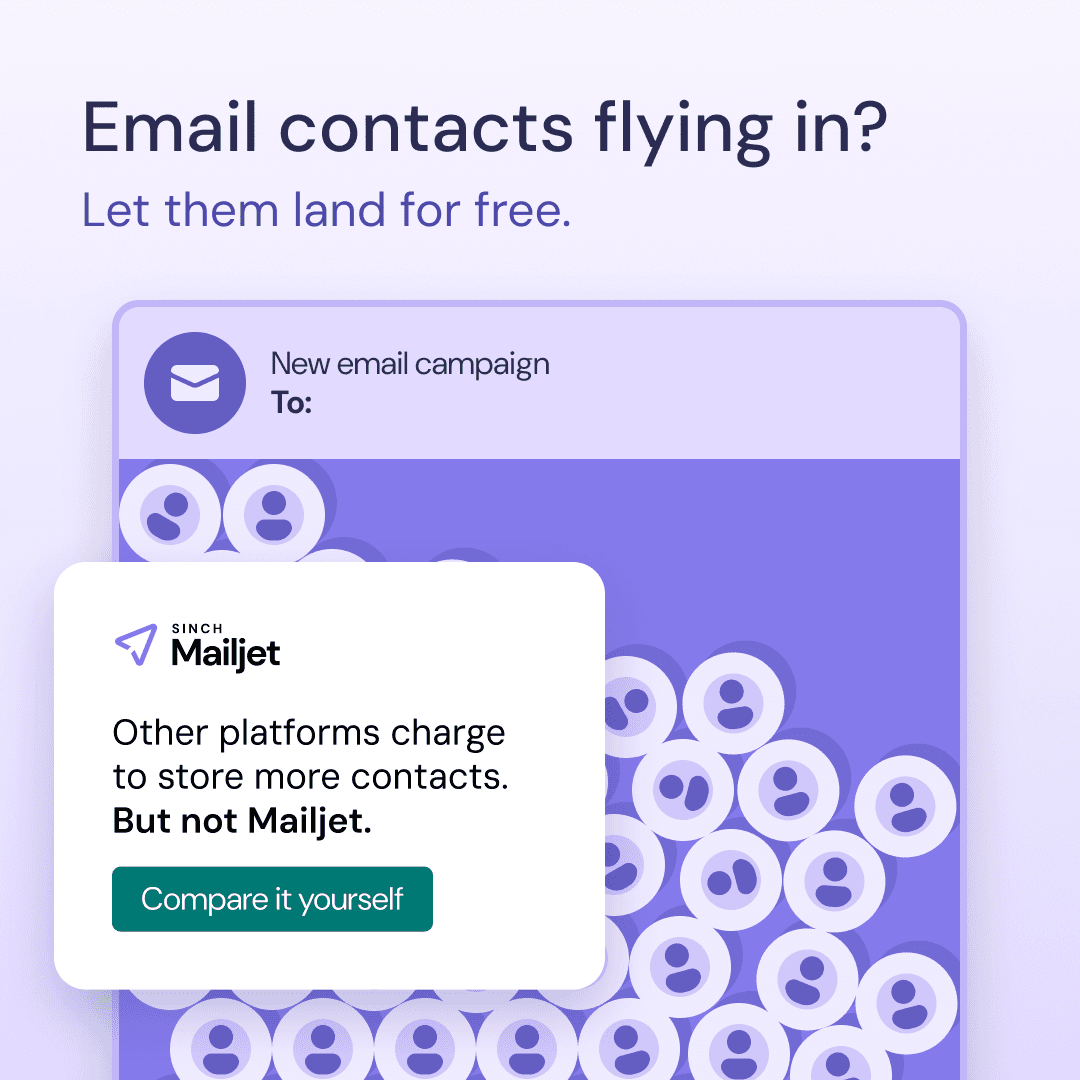


Ad 1 — Contact avatars multiply and fill the screen like a crowd arriving all at once. "Email contacts flying in? Let them land for free." The product UI becomes a landing strip.
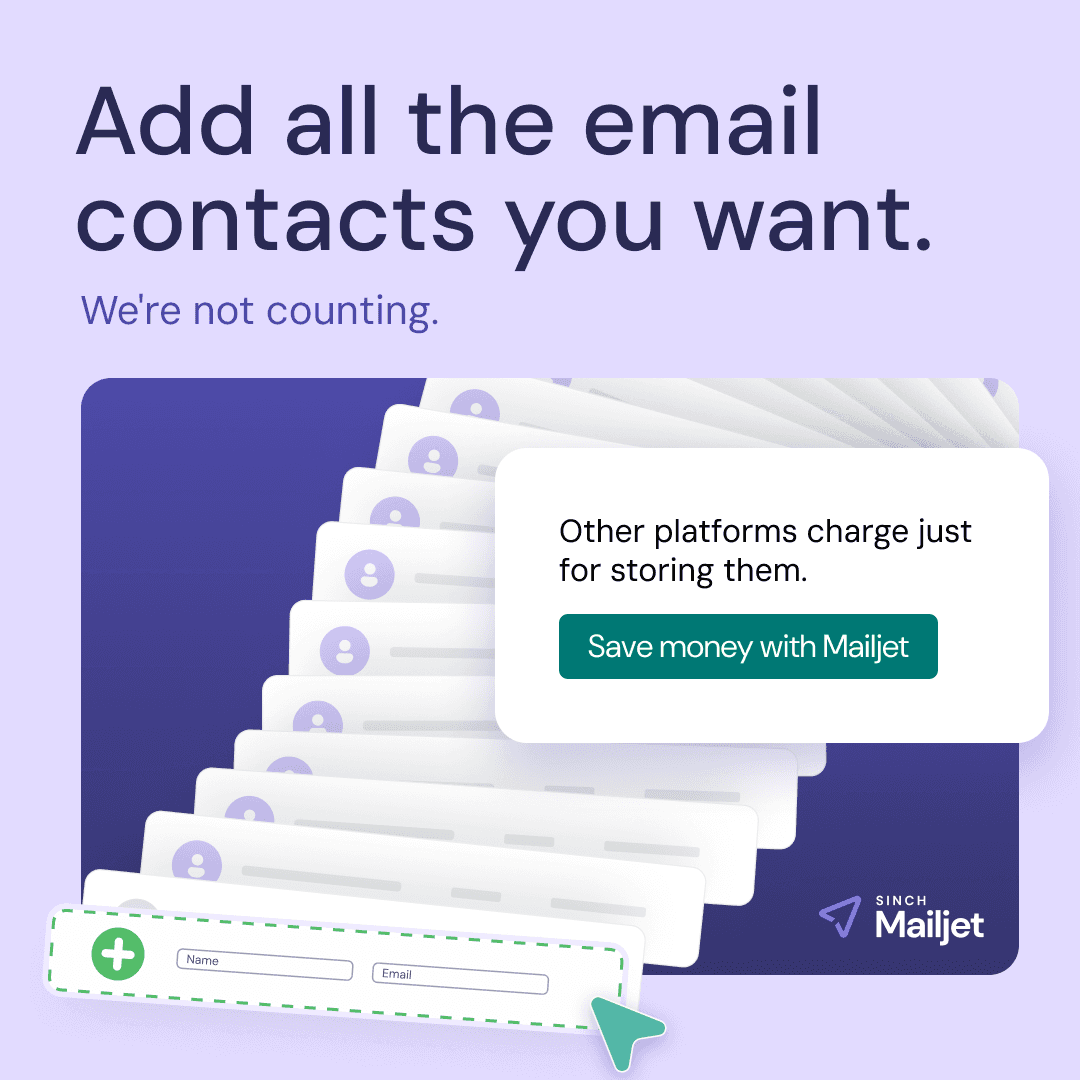
Ad 2 — Contact entries fan out like a deck of cards — abundance, not overload. "Add all the email contacts you want. We're not counting."
Ad 3 — A figure climbs a staircase built from contact entries. Growth as ascent. "Grow your email list, not your costs."
Each execution communicates the same idea through a different emotional register — arrival, abundance, ambition — ensuring the campaign could reach different audiences without repeating itself.
From concept to multi-market campaign.
The concepts were developed in-house, with some input from Words for Breakfast, a copywriting agency based in NZ and Australia. With the static graphics done, they were then handed off to the external creative studio Weltenwandler Designagentur, based in Germany, who produced animated and multi-format versions for display and social channels. The campaign ran across European and North American markets, with assets adapted for multiple languages and formats.
Role: Campaign concept, art direction, visual design, copy direction, agency briefing & management Formats: Social static, display ads, animated variants Markets: EN, FR, DE, ES
A different kind of pricing. A tricky brief.
This project started from the intention of running an ad campaign aimed at our very established competitors, targeting customers on the verge of making a decision. In order to sell Mailjet as the best choice, our pricing model was our best tool.
Most email platforms charge you twice: once per email sent, and again for every contact stored in your database. The bigger your list grows, the more you pay, just for having it.
Mailjet doesn't work that way. You only pay per email sent. Your contacts are free to store, no matter how many.
It's a meaningful difference, especially for growing businesses. But "we have a different pricing model" is not a campaign. The real question was: how do you turn an abstract pricing mechanic into something a person actually feels?
Growth shouldn't come with a penalty.
When your email list grows, that's a win. More subscribers means more reach, more potential, more business. On most platforms though, it also means a bigger bill. Not because you sent more emails, but simply because you have more contacts sitting in a database.
We called it what it is: a success tax. And the campaign was built on a single idea — Mailjet doesn't charge one.
Designing without a net.
This campaign was built during a transitional period for Mailjet's visual identity. The brand was mid-evolution: its original distinctive characteristics were being phased out ahead of a company-wide refresh, which meant there was no established illustration style, no photographic direction, and a limited visual toolkit to work from.
Rather than a limitation, this became a creative opportunity. The campaign needed to develop its own coherent visual language, one that felt like Mailjet, worked across multiple formats and markets, and could be handed off to an external animation studio for production.
Making the abstract tangible.
The visual answer was to take Mailjet's own UI — specifically the contact entry, the most recognisable element of the product — and use it as a physical metaphor throughout the campaign.
The same object tells three different stories across three executions:
Ad 1 — Contact avatars multiply and fill the screen like a crowd arriving all at once. "Email contacts flying in? Let them land for free." The product UI becomes a landing strip.
Ad 2 — Contact entries fan out like a deck of cards — abundance, not overload. "Add all the email contacts you want. We're not counting."
Ad 3 — A figure climbs a staircase built from contact entries. Growth as ascent. "Grow your email list, not your costs."
Each execution communicates the same idea through a different emotional register — arrival, abundance, ambition — ensuring the campaign could reach different audiences without repeating itself.
From concept to multi-market campaign.
The concepts were developed in-house, with some input from Words for Breakfast, a copywriting agency based in NZ and Australia. With the static graphics done, they were then handed off to the external creative studio Weltenwandler Designagentur, based in Germany, who produced animated and multi-format versions for display and social channels. The campaign ran across European and North American markets, with assets adapted for multiple languages and formats.
Role: Campaign concept, art direction, visual design, copy direction, agency briefing & management Formats: Social static, display ads, animated variants Markets: EN, FR, DE, ES
Research
A different kind of pricing. A tricky brief.
This project started from the intention of running an ad campaign aimed at our very established competitors, targeting customers on the verge of making a decision. In order to sell Mailjet as the best choice, our pricing model was our best tool.
Most email platforms charge you twice: once per email sent, and again for every contact stored in your database. The bigger your list grows, the more you pay, just for having it.
Mailjet doesn't work that way. You only pay per email sent. Your contacts are free to store, no matter how many.
It's a meaningful difference, especially for growing businesses. But "we have a different pricing model" is not a campaign. The real question was: how do you turn an abstract pricing mechanic into something a person actually feels?
Growth shouldn't come with a penalty.
When your email list grows, that's a win. More subscribers means more reach, more potential, more business. On most platforms though, it also means a bigger bill. Not because you sent more emails, but simply because you have more contacts sitting in a database.
We called it what it is: a success tax. And the campaign was built on a single idea — Mailjet doesn't charge one.
Designing without a net.
This campaign was built during a transitional period for Mailjet's visual identity. The brand was mid-evolution: its original distinctive characteristics were being phased out ahead of a company-wide refresh, which meant there was no established illustration style, no photographic direction, and a limited visual toolkit to work from.
Rather than a limitation, this became a creative opportunity. The campaign needed to develop its own coherent visual language, one that felt like Mailjet, worked across multiple formats and markets, and could be handed off to an external animation studio for production.
Making the abstract tangible.
The visual answer was to take Mailjet's own UI — specifically the contact entry, the most recognisable element of the product — and use it as a physical metaphor throughout the campaign.
The same object tells three different stories across three executions:
Ad 1 — Contact avatars multiply and fill the screen like a crowd arriving all at once. "Email contacts flying in? Let them land for free." The product UI becomes a landing strip.
Ad 2 — Contact entries fan out like a deck of cards — abundance, not overload. "Add all the email contacts you want. We're not counting."
Ad 3 — A figure climbs a staircase built from contact entries. Growth as ascent. "Grow your email list, not your costs."
Each execution communicates the same idea through a different emotional register — arrival, abundance, ambition — ensuring the campaign could reach different audiences without repeating itself.
From concept to multi-market campaign.
The concepts were developed in-house, with some input from Words for Breakfast, a copywriting agency based in NZ and Australia. With the static graphics done, they were then handed off to the external creative studio Weltenwandler Designagentur, based in Germany, who produced animated and multi-format versions for display and social channels. The campaign ran across European and North American markets, with assets adapted for multiple languages and formats.
Role: Campaign concept, art direction, visual design, copy direction, agency briefing & management Formats: Social static, display ads, animated variants Markets: EN, FR, DE, ES
Design
Design
Design
Development
Development
Development
Concept
Concept
Concept
More Works More Works
More Works More Works

©2024 MANDRO DESIGN
Go Back To Top
©2024 MANDRO DESIGN
Go Back To Top